
I … don’t think she’s gonna make it.
Generic Inspirational Messages Are Harmful
And avoiding ‘labels’ will handicap your kid’s chances of success
“You can do anything you set your mind to.”
“If you can dream it, you can do it.”
“You can be anything you want to be.”
The internet likes to attribute the first quote to Benjamin Franklin, although I can find no source for this and so remain skeptical. The second quote is broadly attributed to Walt Disney, but seems to have been actually written by a copywriter for an advertising agency. The final quote is the only one that does have a verifiable provenance: the self-help author Napoleon Hill, who in the middle of the Great Depression wrote a wildly popular book called Think and Grow Rich.
All of those phrases were part of the cultural air that I breathed growing up. From the time I was old enough to answer the perennial adult-to-child question “What do you want to be when you grow up?” I was told that I could be anything I wanted to be! Anytime I had difficulty with or (perish the thought!) failed at anything, a parent or teacher would tell me — either earnestly or sternly — that I could do anything I set my mind to (and therefore, either implicitly or explicitly, that I must therefore not have been trying hard enough).
I assume most of those adults meant well, but as I look back on the first fifty years of my life, I can assure you that the ‘mind over matter’ philosophy did a lot of damage. So did the way that my parents lauded my natural strengths while firmly rejecting any suggestion that I might also have natural weaknesses — at least, any weaknesses that were not mere deficiencies of character, and therefore wholly under my control.
Let me give one very specific biographical example.
I Was Surprised Every Time
I spontaneously taught myself to read when I was two — so young that I don’t remember not knowing how to read. I do remember catching on that it was unusual — my mother liked to show me off to family and acquaintances, who often didn’t believe that a three-year-old could read until I had repeatedly proved it. I remember being four, the only kid in our preschool asked to sit in front of the class and read picture books aloud for story time.
I walked into kindergarten already reading chapter books on my own, and I did well on the (largely language-based) IQ tests, so I was very quickly labeled ‘gifted’. On the one hand, this did ensure that I was slightly less bored with my schoolwork, but on the other it meant I was expected to perform perfectly at everything, always.
When it came to academics I could mostly meet expectations, although it wasn’t long before my mother began shaming me for possessing only ‘book smarts’ and no ‘common sense’. Starting in second grade I was sent up to third for reading and math. (The school wanted to just skip me completely into third but my parents held me back because they thought I was ‘socially behind’. It was pretty apparent to everyone around me that I was terrible at the expected social skills — but again, this was attributed to character deficiencies. Spoiler alert: even among my age-mates, I remained ‘socially behind’; holding me back academically helped nothing.)
That extra year of math became important later, because it made me eligible to take high-school Algebra I in eighth grade. I breezed through with straight As; the hard part for me, in fact, was the tedium of properly ‘showing my work’ when most of the time I could look at a quadratic equation and intuit the correct answer without any sense of how I got there.
And then in ninth grade, cruising along on my advanced-math track, I hit Honors Geometry … and I choked. I didn’t just get Bs — that year I brought home my first-ever C grade, and it wasn’t because I hadn’t turned in homework or because I was docked for reading novels in class (which I tended to do in classes that bored me). No, I was doing my genuine best, and I couldn’t understand why it wasn’t working.
The next year I went on to Honors Algebra II, where I easily racked up straight A-pluses once again. Then my junior year, Trigonometry, and … right back into inexplicable Bs and Cs.
No adult ever explored the possibility that this was indicative of anything other than a lack of commitment on my part, but privately I figured that this struggle was an indication that I should remove myself from the STEM pipeline. Against all expectations, I refused to take calculus my senior year, and I pursued purely liberal arts in college.
Skip ahead a few years. After winning a couple of writing contests, I had decided to be a fiction writer. I had published several short stories, and in my mid-twenties I moved to New York on the promise of a job in publishing. But that job never materialized, and because 1) writing short fiction paid for shit and 2) at that precise point in time the web was exploding into existence and jobs in tech were popping up like mushrooms after rain, I ended up bootstrapping myself into a career in web design.
I pursued that career for fifteen years, and the more time passed, the more I began to feel just like I did in ninth-grade geometry class. I would succeed for a bit, and then fail. I would think I nailed an interview, and then get passed over for the job. Or I would get a job, then get fired. I would get promoted, and then demoted. I would gain a client, then lose them.
I was surprised every time. I might have veered away from advanced math, but I was still getting the message that I ought to be able to succeed at anything … even as my career trajectory objectively failed to follow an upward arc. The failures began to compound themselves, as it became less and less possible to hide the gaps in my resumé, while the competition for jobs in the industry intensified.
Finally, the preponderance of evidence became too great; I started to believe there was something really wrong with me, something that I couldn’t begin to fix because I didn’t even understand what it was. I became deeply ashamed of my career failure, which in work-obsessed American society meant I was deeply ashamed of myself as a person.
Each of these features of my brain affects the ways in which I am able to work.
None of them are deficits in my character.
A long time later, at age forty-nine-and-a-half, I fell down a rabbit hole of self-discovery. It began when I recognized myself in descriptions of other women with autism, and continued for the next two years (and counting?) as I explored an expanding web of common comorbidities and related neurodivergence.
A whole bunch of things have subsequently fallen into place, including but not limited to:
- My precocious reading ability and subsequent facility with (and intense focus on) written language isn’t indicative of across-the-board ‘giftedness’ but rather hyperlexia, an autism-related condition, a kind of ‘savant skill’ that is usually accompanied by deficits in other areas.
- In my specific case, one of those deficits is a visual-spatial learning disability. Of the twelve traits on that linked page, I check off eleven (and the exception, that of verbal skills exceeding written skills, is explained by my hyperlexia). This is why I became so suddenly lost when I encountered spatial forms of math — and why I have always become physically lost very easily. It’s why I am relentlessly terrible at estimating how long anything will take, or even knowing how much time has passed. And much more.
- I am also borderline aphantasic. On a scale of zero to four, where zero is ‘complete and total absence of any mental imagery’, and four is ‘hi-def cinematic brain movies’, I score at best a one. Most of the time, if my mind’s eye contains anything at all, it’s a vague sense of color. If I make a special effort, I can get blurry blobs. If I try to focus on a specific tiny detail — and it’s something I’ve seen many times before, rather than something new or wholly imaginary — it gains clarity, but everything around it vanishes. So, for example, I can almost visualize the left eyebrow of my partner of twenty years, but I can’t imagine his whole face.
Many, if not most, of my employment-related difficulties can be chalked up to the fact that despite my very best efforts, my autistic ass consistently fails to grok a certain fraction of neurotypical social norms and expectations. Along with autism, I also have sensory processing disorder, central auditory processing disorder, a mild form of dyspraxia, and I’m about 97% certain that I would qualify for a diagnosis of ADHD (inattentive type), if I were able to be tested today. (I can’t verify this because adult ADHD diagnosis is not available where I live now, which is a shame because drugs to help with my executive function would be a tremendous blessing.)
Each of these features of my brain affects the ways in which I am able to work. None of them are deficits in my character.
Current Happiness, Retrospective Anguish
While I was in the middle of writing this essay, a friend (who is roughly my age, and has been on her own journey of neurodiscovery) wrote on Facebook:
I just found out that dyscalculia is a thing, like dyslexia but with math — and while it makes perfect sense that it exists and is often linked to ADHD and autism, the knowledge of this learning disability (and that I very likely have it) would have made such a HUGE difference to my life when I was in school. I’m not just willfully lazy with numbers: I actively don’t understand many concepts in math, and there’s a reason for that. All those hours crying because I thought I must be so stupid. I wish I could go back and tell myself about this.
This is exactly why honest self-knowledge is better than generic messages of inspiration, even (especially) for kids and teens. If you’re not testing your kids because you’re afraid that they’ll be stigmatized by a label, you’re doing them a tremendous disservice. Likewise if there’s been a diagnosis, but you’re hiding it from your kid because you’re afraid the knowledge will limit them. Not understanding our own neurodivergence doesn’t alter our natural capabilities, it just makes us miserable and misunderstood, and causes us to make bad choices.
If, as I entered adulthood, I had understood even just those first three things in the list above — my hyperlexia, my visual-spatial learning disability, and my aphantasia — I would never have chosen a career that relied heavily on spatial visualization. It now makes sense, for example, why I often failed to live up to expectations of speed in my design work: I had to physically create a mock of an idea before I could evaluate its merits, and then I had to physically iterate through any changes, until I achieved something that looked right. Meanwhile, many other designers completed the visualization and iteration in their minds, and were able to skip right to the end state. I compensated to some extent by being fast and agile in Photoshop, but I couldn’t completely overcome the fact that I was doing a lot more actual work to get to the same endpoint.
What would I have done instead, if I had known these things about my brain thirty years ago? I would have used my connections in publishing to start a career as a freelance proofreader. I am an excellent proofreader: my hyperlexia makes me a ridiculously fast reader, my autistic attention to detail means I rarely miss an error, and my aphantasia actually becomes an asset, rather than a deficit: people who have snapshots or movies playing out in their brains while they read can’t pay as much attention to the actual letters and punctuation on the page as someone like me can.
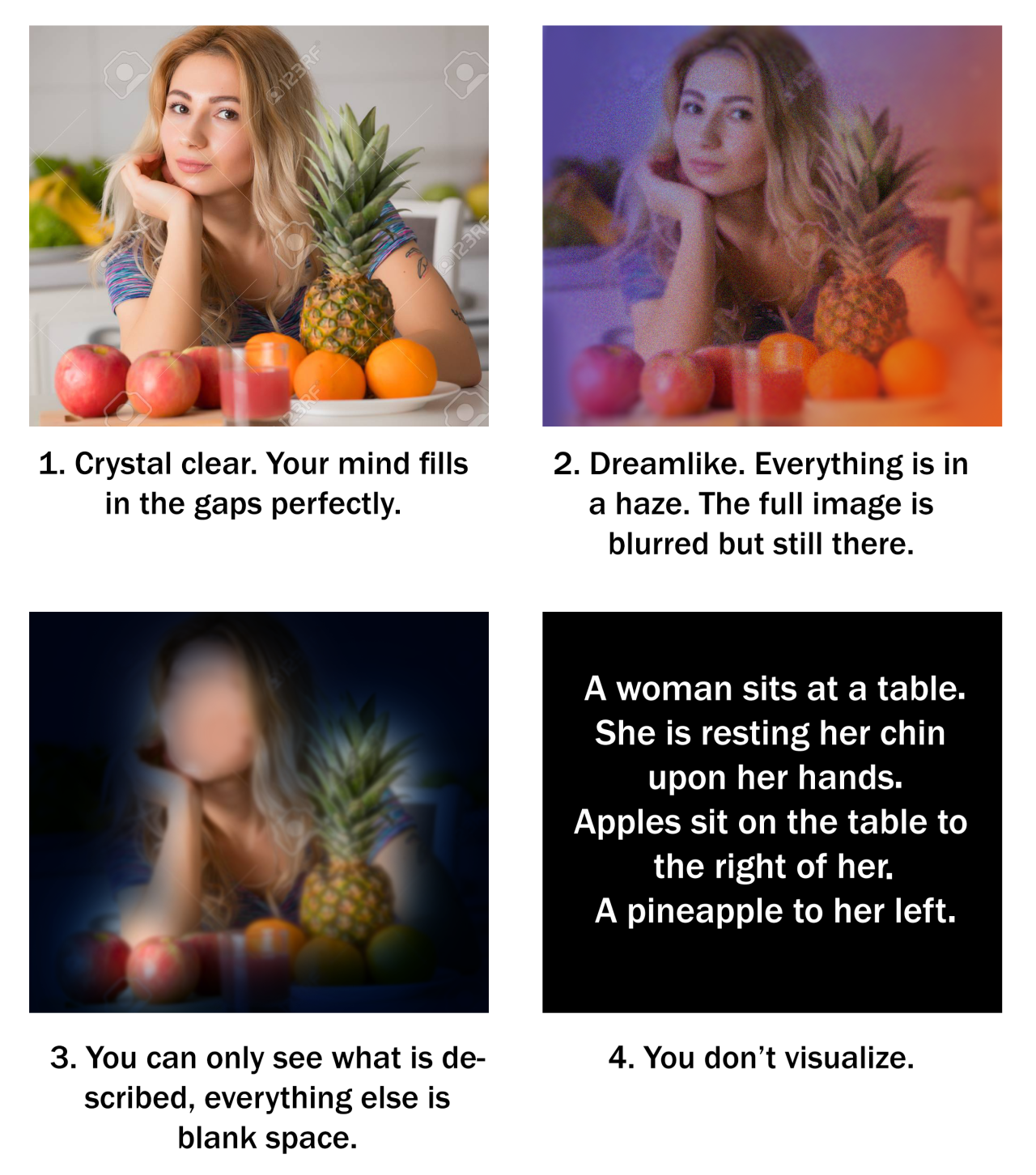
When you read, what do you see?
I‘m a 4 most of the time, with occasional moments of about 3.5.
Over the past couple of years I have actually been picking up significant work as a freelance proofreader, and the feedback I’ve gotten has been extremely positive. (Freelancing from home also keeps me far, far away from ‘office politics’, which is the number-one bane of my autistic existence.) This development is equal parts current happiness and retrospective anguish, because I could have been doing this all along.
Self-Knowledge Is Not Limiting
“You can be anything you want to be, if only you believe with sufficient conviction and act in accordance with your faith,” wrote Napoleon Hill, “for whatever the mind can conceive and believe, it can achieve.”
Napoleon Hill was an inveterate liar and a world-class fraud, but this hasn’t stopped his scammy ideas from being picked up by a long line of (and I use this phrase with extreme irony) ‘self-help experts’, from Norman Vincent Peale (The Power of Positive Thinking) to Rhonda Byrne (The Secret). They’ve been quoted in song lyrics by Freddie Mercury and Eminem. It’s a challenge to scroll through Instagram or Etsy without running across some version of the above sentiment. Generic inspirational messages are still the cultural air that we breathe, and they are still toxic.
I know these sorts of ideas are popular because we are all desperate to believe we’re in control of our lives. But belief never has been, and never will be, sufficient.
We shouldn’t handicap our kids by assuring them that everything is possible. Not everyone has the same advantages, and no one can do everything equally well. Our best chances of success — in work and in life — lie with leaning into our natural strengths, and looking for ways in which even our weaknesses might work in our favor.
Self-knowledge is never limiting: it’s freeing.