The ‘Deep Compensation’ of Social Calculus
Some autistic brains do a lot of heavy lifting behind the scenes
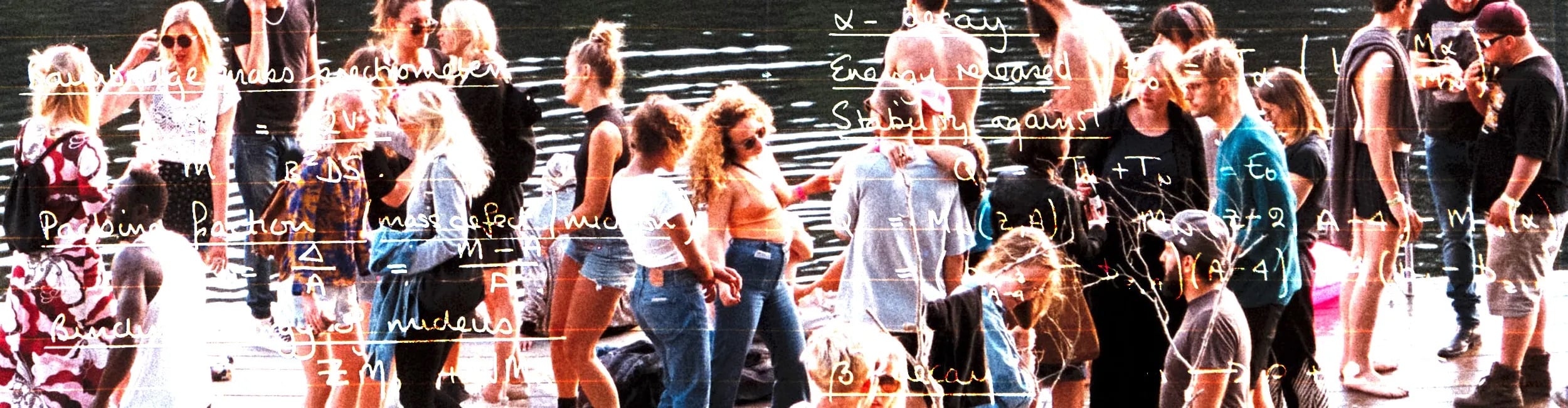
When I was twenty-four, in the course of a conversation with my therapist, I created an analogy that I would use throughout my life: when I walk into a room of people, I immediately start running ‘social calculus’ on everyone in sight.
It really did feel like doing advanced math: it was that complicated, that deliberate. And I could tell, even by twenty-four, that I was putting out more effort than everyone else I knew. Other people seemed to be doing social arithmetic, not social calculus. Their conscious awareness was surface-level at best. They didn’t analyze every fleeting facial expression or nuance of body language; they didn’t observe conversational patterns in search of clues that might reveal a person’s personality or motivation.
The more people I had to interact with at one time, the harder everything became. With one person I could monitor all of her nonverbal emotional cues, process the semantic content of her speech, and analyze the decision tree of possible responses, while constantly running subroutines to ensure that I spoke at the correct times and not too much, that my face was making the appropriate expression from moment to moment (interest, amusement, sympathy), and so on. Each extra person, even if they weren’t speaking, was a whole new locus of body language that I had to monitor and respond to; once multiple conversations were happening, as in a party, I often became overwhelmed.
I couldn’t always make it all come together — never in a large group, I think, before my early twenties, and only intermittently thereafter. Sometimes everything was just a cacophony of input, and I couldn’t think fast enough to sort through it all and figure out the right way to insert myself — which usually meant that I would stand, alone in a crowd, burning all my cycles on trying not to appear as anxious and humiliated as I actually felt. I learned that alcohol reduced my anxiety, but also my capacity for observation and calculation; the anxiety was debilitating, so that became a tradeoff I often made.
But then, on the times I did manage to send my brain into that hyperdrive of serial processing, and people responded positively, it felt amazing. It was like conducting a full orchestra while simultaneously playing all the instruments. I felt brilliant, capable, and — briefly — socially successful.
By my early twenties I also knew that being around people fatigued me more or less in inverse proportion to how well I knew them. I chalked this up to ‘introversion’, having no better explanation. I suspected my constant physical exhaustion, which seemed to be an order of magnitude greater than even the other self-proclaimed introverts I knew, might be ‘chronic fatigue syndrome’. I assumed that most of my mental difficulties, especially my social anxiety — which though it might sometimes diminish over the course of a particularly successful social interaction, would inevitably reappear at full strength on the next occasion — were a result of my CPTSD.
In the decades before I knew I was autistic, I also figured social calculus was a hypervigilant strategy I’d adopted as a result of my abusive childhood. But though it may have begun as self-protection, I used it to help other people as much as possible. As someone who has so often been on the outside, I am uncommonly sensitive to other people who are struggling. I am often the one person who will notice someone hovering just beyond the circle of conversation, and angle my body to make space, or who will cross a room to speak to a person standing alone and looking awkward. I will recognize when someone is repeatedly being interrupted, and make a point of turning to her and asking her to continue.
It was like conducting a full orchestra while simultaneously playing all the instruments. I felt brilliant, capable, and — briefly — socially successful.
Over the past quarter-century I’ve described my concept of ‘social calculus’ to many dozens of people: sweethearts, friends, and a long series of therapists. I explicitly referred to my theory that other people were doing ‘social arithmetic’ — less mental work, generally resulting in reduced awareness. In this construct I was, at my best, one of the most socially aware and adept people I’d ever met.
I never imagined, nor did any one of those people ever suggest, that other people don’t do social math of any sort. That most people might not need to consciously run all of those calculations, on themselves and others.
It was only when I started to suspect that I was autistic, and began to listen to the experiences of late-diagnosed autistic women, that I ever heard anyone describe an internal process that I recognized, or learned that most people weren’t doing any such thing.
Turns out, I wasn’t just doing more work than everyone else, I was doing a completely different kind of work.
There’s been a lot of discussion in the past few years, among both autistics and autism researchers, about the concept of ‘masking’ autism. Masking focuses on the self-monitoring and performative aspects of social interaction, and it can be either conscious (like the way I choose facial expressions deliberately, just as I learned to do on stage) or unconscious (like the way I use tactile stims that don’t draw attention to themselves).
The idea of ‘masking’ incorporates one part of what I thought of as social calculus. But the other part— the complex, multifaceted monitoring and assessment of other people — was not something I was seeing discussed or named. I began to wonder if I’d been right before: maybe that aspect of ‘social calculus’ was related to CPTSD, and not autism at all.
Then I discovered a cognitive psychologist in London, Lucy Anne Livingston, who is studying ‘social compensatory strategies’ in autism. In a paper published in July of this year, 2019, she differentiates between ‘shallow compensation’ (imitating without regard for context), and ‘deep compensation’ (mental algorithms to plot patterns of behavior):
Deep compensation … involving complex and flexible strategies, contributed to some improvements in social cognition. Some participants reported using pattern detection and internal data modelling (gesture + facial expression + context = particular mental state) to understand others. These strategies, although hard to implement at first, could become “second nature” with time.
One autistic study participant explained:
I think I observe patterns in behaviour and then try to transfer this. So if a person is behaving x/y/z types of ways, they could be feeling or thinking what so and so people had felt. It’s almost a case of systematically storing little patterns in each person and the context, so I can refer to it in future.
There it was at last: ‘deep compensation’ is — or perhaps includes — my ‘social calculus’.
My delight at having this recognized and validated is boundless. I feel seen, in a completely non-ironic way.
But before you get excited and think “Hooray, autistics can all learn to compensate and be just like neurotypicals,” let me tell you a few other things.
One, not all autistics are capable of compensation, or of compensation at all levels. I’m lucky in some ways, because I do not have an intellectual disability, and while I do have some executive function deficits, my difficulties in that area seem to be milder than most autistic people experience. Both high IQ and executive function capability are correlated with the compensation phenomenon in autistics.
Two, just because someone can compensate sometimes, for some things, does not mean that same person can always compensate for everything. The study of how to ‘properly’ human has been my life’s great work, starting from the age of thirteen … and it is no exaggeration to say that I’ve put as much time and effort — as much research, introspection, consultation, everything — into approximating neurotypicality as anyone ever put into getting a PhD.
Yet I can still look back and see that I failed to approximate sufficiently at every turn. Not only did I fail at parties far more often than I succeeded, but I repeatedly lost sweethearts, friends, and jobs for what I now recognize as autistic ways of thinking or acting.
Three, compensation takes a tremendous toll on one’s physical and mental health. This is widely reported in the autistic community, and backed up by recent scientific studies. All those years I wondered about chronic fatigue syndrome — nope, turns out that constant exhaustion is just what happens to autistics trying to exist in a world full of neurotypicals. (Or, alternatively, maybe yes? Doctors and scientists don’t know what causes CFS; is it possible that many sufferers are undiagnosed, compensating autistics?)
In a 2017 survey of autistic adults, researchers used the catch-all term ‘camouflaging’ to cover the various ways autistics mask and compensate in social situations with neurotypicals. They reported that:
By far the most consistent consequence of camouflaging described by respondents was exhaustion. Camouflaging was frequently described as being mentally, physically, and emotionally draining; requiring intensive concentration, self-control, and management of discomfort. The longer a camouflaging session continued, the harder it became to maintain the intended level of camouflaging. Many respondents reported needing time to recover after camouflaging, where they could be alone and release all of the behaviours they had been suppressing.
This is not only completely true for me, it’s not even a one-to-one ratio. One evening spent with a group of people knocks me out for an entire day. I plan for this now, and spend most of the following day in bed, reading and sleeping, interacting with no one except my spouse (with whom I no longer need to mask).
But when I had no choice except to spend five long days in a row in an office with coworkers, my mask was much flimsier, simply because ‘social arithmetic’ was the best I could manage on a regular basis — and even so, I would often be unable to stay awake for the whole nine or ten hours in a row. Crawling off for a nap in the afternoon — or falling asleep at one’s desk — is not looked upon kindly by Corporate Overlords, but for me it was never a matter of choice. Likewise, in a culture where actually using one’s measly ten annual days of vacation time is considered evidence of a lack of proper commitment to one’s work, calling in sick or ‘taking a mental health day’ is a career-limiting move, and risks outright dismissal.
What we autistics really need is for neurotypicals to understand how desperately hard we are working, always, to meet you in your places and on your terms.
While the ability to approximate neurotypicality — even occasionally — is of undeniable benefit in this majority-neurotypical world, it is not a panacea, a solution, or a cure.
What we autistics really need is for neurotypicals to understand how desperately hard we are working, always, to meet you in your places and on your terms. At the very least, we need time and space to recover from that stress without risking our relationships and our livelihoods. And in a truly just world, neurotypicals would meet us partway.
My neurotypical husband has done this; over the nineteen years of our relationship we have hashed out a functional, mutually-beneficial way of communicating and coexisting which — while a compromise on both sides — is probably more typically autistic than allistic. I only wish that this were not as rare a phenomenon in the wider world as it is.